
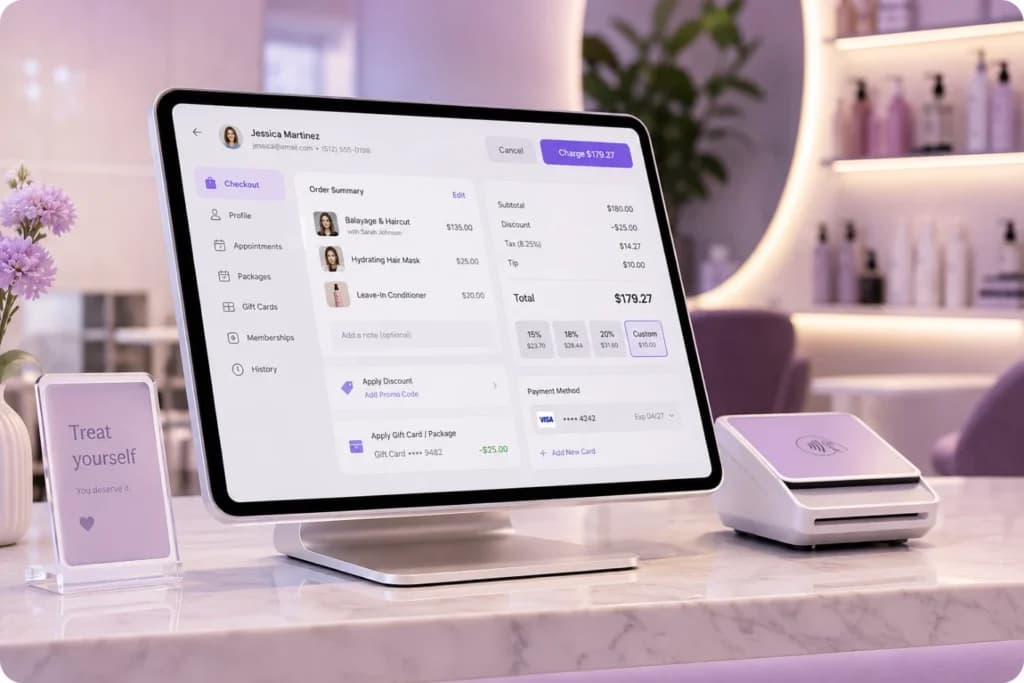
Getting paid should be the easiest part of running a salon or spa. For most owners, it isn’t.
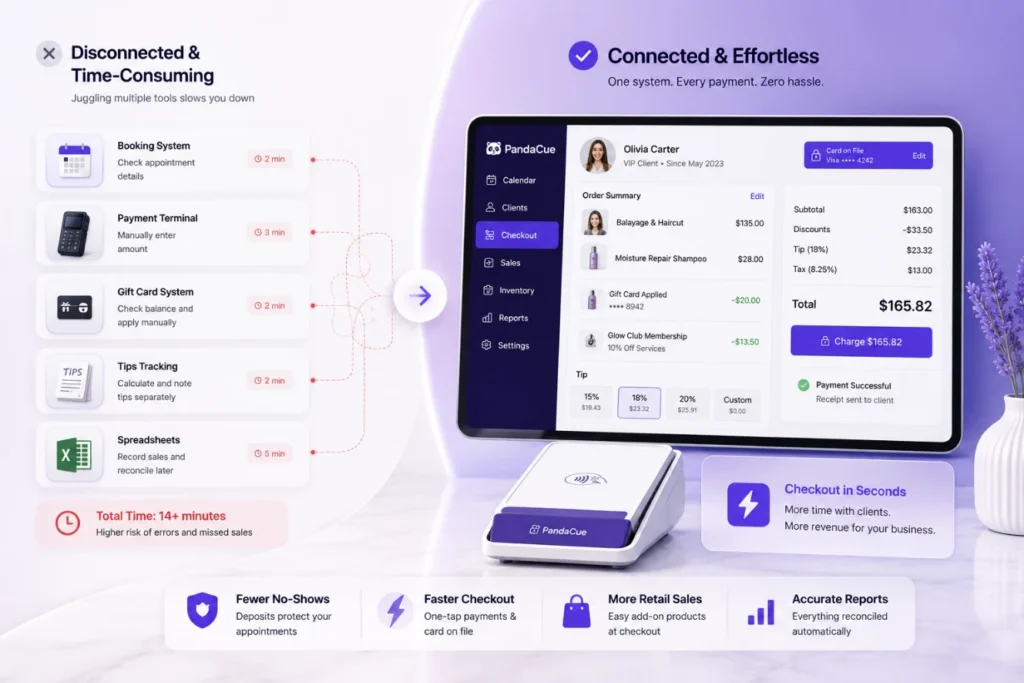
You’ve got a card reader from one company, a booking app from another, a separate system for gift cards, and a spreadsheet for tips. Checkout takes longer than the service itself.
PandaCue’s Payments & Point of Sale feature puts all of that in one place, so your front desk can check a client out in seconds instead of minutes.
What Is Payments & POS in PandaCue?
Payments & POS is the part of PandaCue that handles every dollar moving through your business.
It combines card processing, deposits, retail sales, tips, gift cards, and financial reporting into one checkout screen.
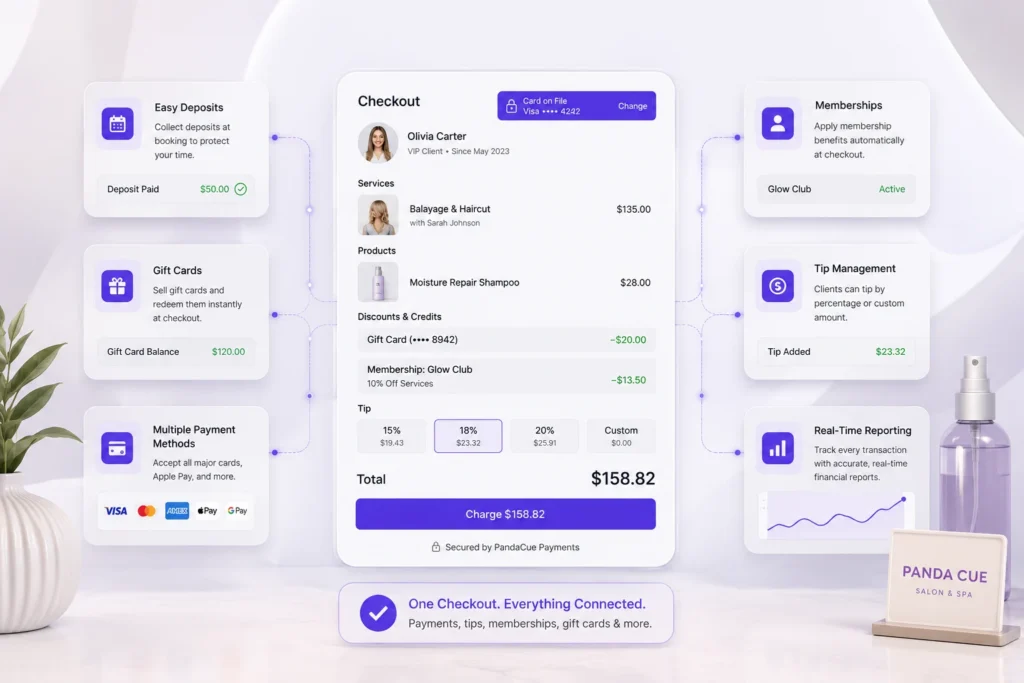
Your staff never has to switch between a booking system and a separate payment terminal.
This matters because checkout is where most small mistakes happen. A missed tip. A gift card that doesn’t sync with the calendar.
A deposit that never got collected before a no-show. One connected system removes most of that risk.
Why a Connected Payment System Matters More Than It Seems
A lot of salon and spa owners treat payments as an afterthought. It’s the last click before a client walks out the door.
But how you collect money shapes almost everything else in your business.
Deposits protect your calendar
If you don’t collect anything upfront, a last-minute cancellation costs you a filled appointment slot you can’t get back. A deposit, even a small one, gives clients a reason to show up.
Card on file speeds up every future visit
Once a client’s card is stored securely, rebooking and checkout take seconds. No fumbling for a wallet. No re-entering card numbers.
Retail sales depend on a smooth checkout
If ringing up a bottle of serum next to a facial takes an extra five minutes of app-switching, your staff will stop suggesting it. A combined checkout makes upselling retail a natural part of the conversation, not an extra chore.
Clean reports save you at tax time
When payments, tips, and product sales all live in one system, your reports already match your bank deposits. You’re not reconciling three different tools every month.
Key Concepts Every Owner Should Understand
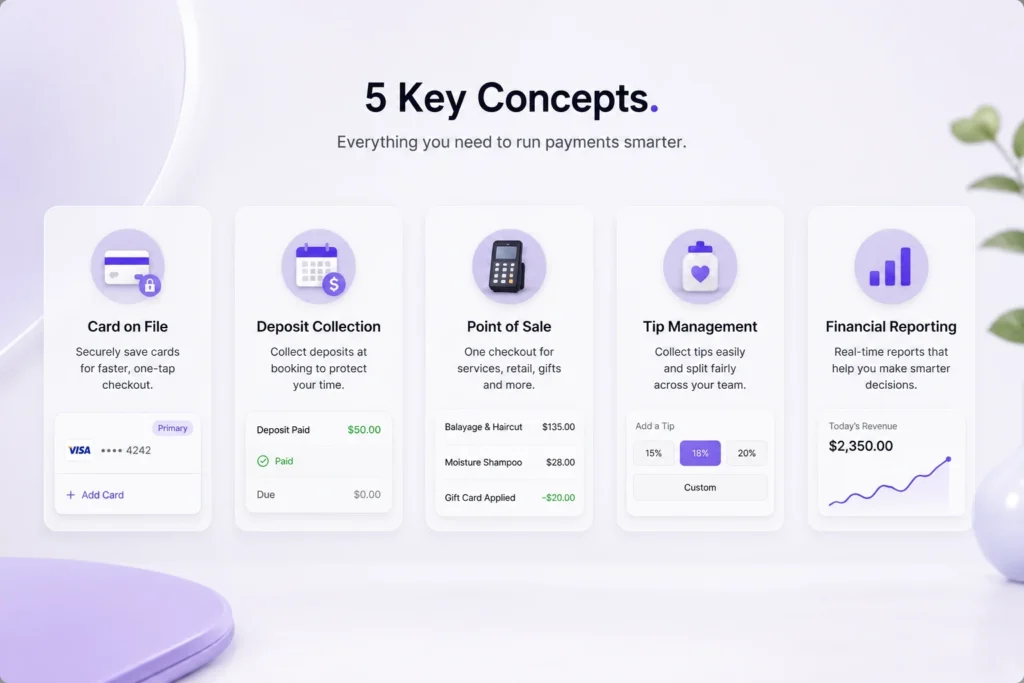
Card on File
This means a client’s payment card is stored securely in their profile, ready for future charges. It’s what makes one-tap checkout possible, and it’s also how you enforce a no-show or late cancellation fee without an awkward conversation.
Deposit Collection
A deposit is money collected at the time of booking, before the appointment happens. It protects the time slot for you and shows the client is serious about keeping it.
Many owners set this up for high-value or high-demand appointments only.
Point of Sale (POS)
POS refers to the actual checkout moment, whether that’s a service, a retail product, a membership payment, or a gift card redemption.
In PandaCue, all of these can happen in a single transaction instead of four separate ones.
Tip Management
This is how tips get collected, split between staff, and reported. A good system lets clients tip by percentage or dollar amount and splits automatically between multiple providers if more than one person worked on the appointment.
Financial Reporting
These are the reports that tell you what actually happened financially: revenue by service, by staff member, by location, and by day.
Reporting turns raw transactions into decisions, like which services are worth promoting and which staff members are driving the most retail sales.
Common Payment Mistakes Salons and Spas Make
Not collecting deposits for popular time slots
Friday afternoons and weekend mornings get booked fast and cancelled often. Skipping a deposit here is where owners lose the most revenue to no-shows.
Running retail and service payments through separate systems
This forces staff to do double the work at checkout, which means they eventually stop bothering with retail suggestions altogether.
Splitting tips manually with cash or notes
Manual tip tracking creates disputes between staff and makes payroll take longer than it should.
Ignoring reports until tax season
Waiting until March to look at a year of revenue reports means you’re reacting to problems instead of catching them early.
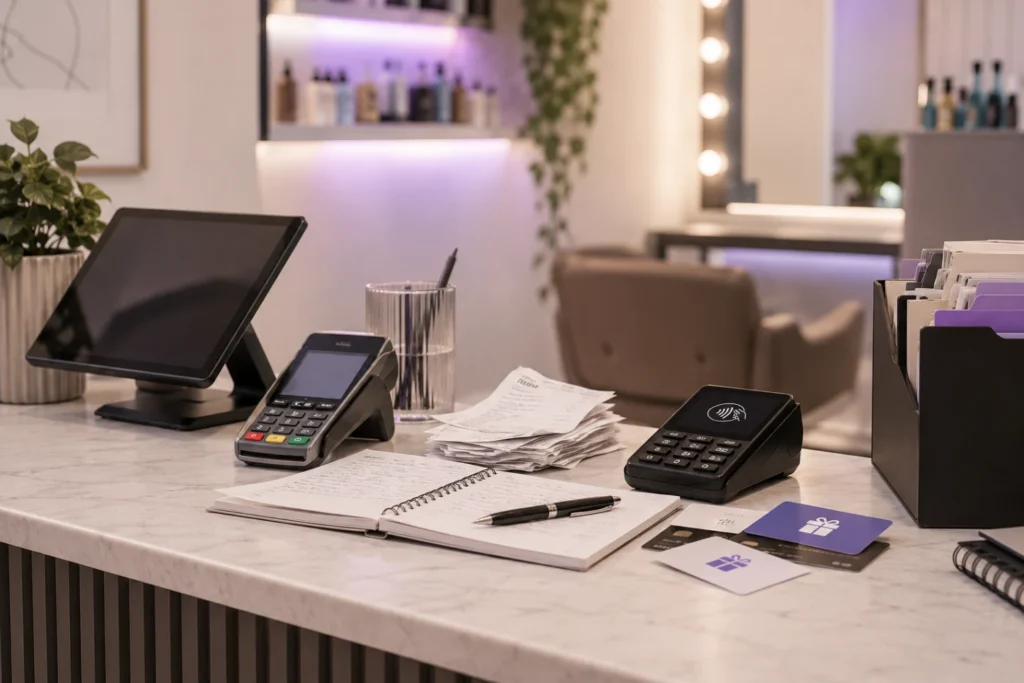
Storing card details in unsecured spreadsheets or notebooks
This is a serious compliance risk. Card data needs to sit inside a system built for it, not a paper file or a notes app.
How Checkout Works With PandaCue’s Payments & POS
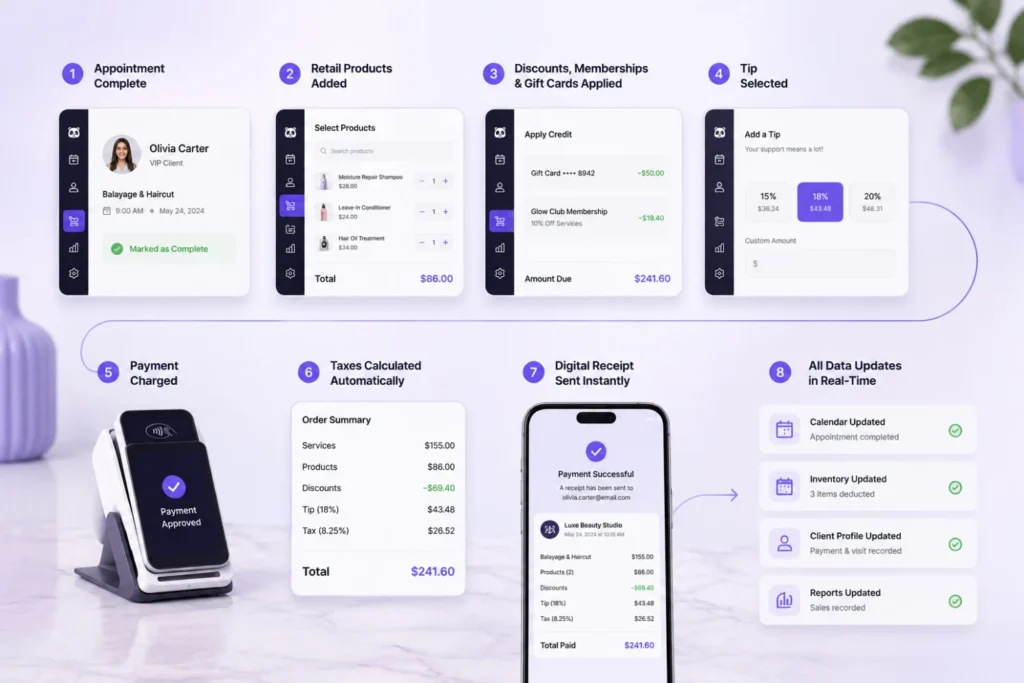
- A client arrives for their appointment. Their profile, including any card on file, membership, or package balance, is already pulled up.
- The service is marked complete. The system moves the appointment straight into checkout, with the service total already calculated.
- Retail products get added if needed. A staff member can scan or select a product, and inventory updates automatically.
- Gift cards, memberships, or packages are applied. Any credit or discount the client has gets applied without manual math.
- A tip prompt appears. The client can tip by percentage or a custom amount, right on the checkout screen.
- Payment is charged. For a returning client with card on file, this is a single tap. Taxes calculate automatically.
- A digital receipt sends instantly. No paper, no printer jams, no lost receipts.
The whole process usually takes under a minute, even with retail added on.
Payments and POS Connect to the Rest of Your Business
Payments don’t exist in isolation. They connect to nearly every other part of how a salon or spa runs.
Deposits collected at online booking protect your calendar before a client ever walks in.
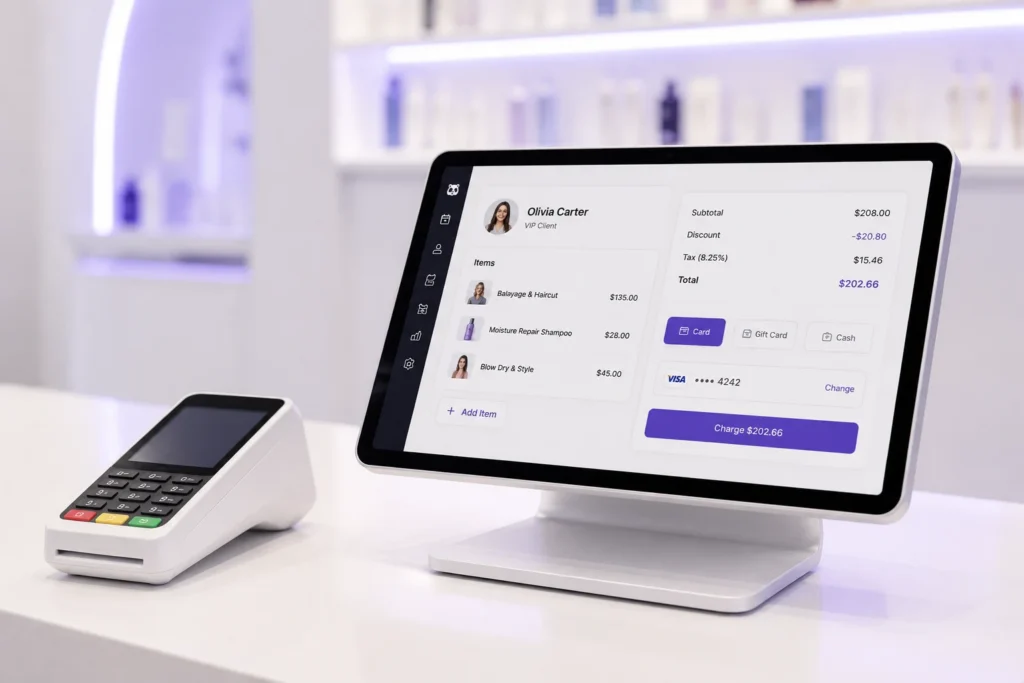
A client’s payment history feeds directly into their profile inside your CRM and client management tools, so front desk staff always know who’s a regular and who owes a balance.
Memberships and package redemptions get applied automatically at checkout instead of tracked on a separate spreadsheet. And gift cards sold at checkout can be redeemed the same way, months later, without anyone digging through old records.
Keeping payments manually separate from booking and client records gets harder as a business grows.
Software like PandaCue connects checkout directly to your calendar, client profiles, memberships, and gift cards, so your staff spend less time reconciling numbers and more time with clients.
Frequently Asked Questions
Does PandaCue replace my card reader?
PandaCue’s Payments feature includes integrated card processing, so you don’t need a separate standalone terminal system running alongside your booking software.
Can I require a deposit for only certain services?
Yes. Most salons and spas set deposit requirements on high-demand or high-value appointments, like injectables or color services, while leaving simple services deposit-free.
How does tip splitting work if two staff members worked on one client?
The checkout screen lets you split a single tip between multiple staff members based on percentage or a fixed amount, and it reports correctly for each person’s payroll.
Is storing a client’s card on file safe?
Yes, as long as it’s stored through a proper payment system rather than a spreadsheet or notes file. This is also what allows for no-show fee enforcement without manual card entry each visit.
Can I track which staff member sells the most retail?
Yes. Financial reporting breaks down revenue by staff member, so you can see who’s driving product sales alongside services.
Do reports work for tax season?
Reports are exportable and organized by day, week, and month, covering revenue, tips, and taxes, so they’re ready to hand to an accountant without extra cleanup.
Final Words
Payments are the one part of your business every single client interacts with, every single visit.
A slow or disconnected checkout costs you time today and revenue over the long run, through missed deposits, forgotten retail sales, and messy reports.
A connected Payments & POS system fixes the small leaks that add up over a year: the no-show that could’ve been prevented, the retail sale nobody suggested, the tip that got miscounted.
Get checkout right, and the rest of your operations get a little easier too.